Cougars at Risk
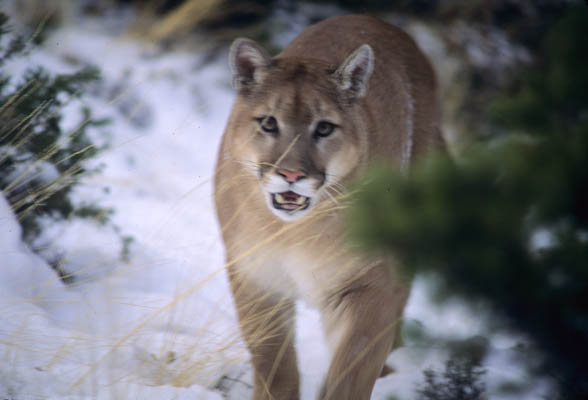
Photo by George Wuerthner
Elusive and extremely shy, America's extraordinarily beautiful wildcat, the cougar,
was called "the spirit of the mountains" by the Native Americans. Cougars pose very little
threat to people, yet each year thousands are needlessly killed for sport. We're working to
protect this keystone species.
Cougars Are Not a Threat to Public Safety; Get the Facts
Since 1890, there have been only 25 confirmed fatal cougar attacks on people in all of North America—that's only 25 deaths in about 130 years. To put these numbers in perspective, you are at far greater risk from being shot by a hunter, killed by lightning, bees, dogs, or cattle. For example, every year about 100 people in the U.S. and Canada are fatally shot by hunters and 20-30 are killed by dogs. See cougar myths & facts
While many states use lethal control methods to protect the public when cougars accidentally enter human-populated areas, California found a better way. Not only have they not allowed hunting of cougars in over 30 years, but they approved groundbreaking legislation that changed how they handle public safety issues.
As of Jan. 1, 2014, California will only kill a cougar if it is posing an imminent threat to human life, i.e., exhibiting aggressive behavior towards a person that is not due to the presence of first responders. All other situations must be handled with non-lethal force, which includes capturing, pursuing, anesthetizing, temporarily possessing, temporarily injuring, marking, attaching to or surgically implanting monitoring or recognition devices, providing veterinary care, transporting, hazing, rehabilitating, releasing, or taking no action. See California's groundbreaking legislation requiring non-lethal control of cougars (Fish & Game Code, Section 4801.5)
Does Killing Cougars Decrease Potential Conflicts with People and Livestock?
Research at the Washington State University Carnivore Conservation Laboratory found that heavy hunting of cougars actually increases conflicts between humans and cougars. These findings run contrary to presumptions of wildlife management programs designed to continually increase kill numbers. Read detailed comments by Dr. Wielgus, former director of WSU lab
Also, new peer-reviewed research by John Laundré, Ph.D., published in PLOS ONE in February 2020 shows:
- Evidence does not support hunting as a way to control cougars: Study - OPB.org, Feb. 24, 2020
He's One Cool Cat: History and Lifestyle of America's Lion
North America is home to one of the world's most extraordinary and beautiful wild cats, the cougar. Majestic and mysterious, cougars are elusive and secretive by nature. Because of this, Native Americans referred to them as "the spirit of the mountains."
Cougars' geographic range once spanned from northern British Columbia to Patagonia, and from the Atlantic to the Pacific coasts. Because of predator control and habitat loss their range has been diminished by about 50 percent, leaving them primarily inhabiting the western states.
The chance of ever seeing a cougar, much less being attacked by one, is extremely remote. There has never been a documented cougar attack or fatality in Oregon's history, yet the Oregon Department of Fish and Wildlife calls for more cougar killing every year in the name of public safety.
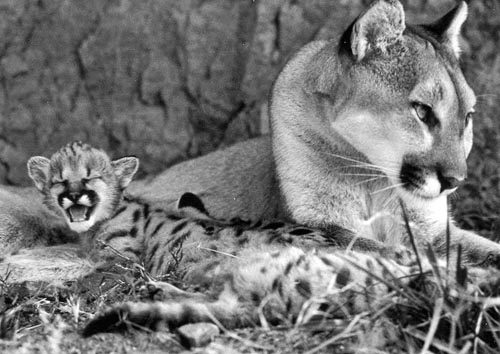
Photo by Bill Dow
Cougar Facts
Also known as a mountain lion, panther, ghost cat, catamount and puma, the cougar's Latin name, felis concolor, means cat of one color. Adults are tawny brown with black-tips on their ears and their long tails. On average, females measure 7 feet from nose to tail and weigh between 70 and 100 pounds. Males may reach up to 8 feet in length and weigh between 130 and 150 pounds.
Cougars can live in densely forested regions or in open sagebrush habitats. Their territories can range from 25 to 100 square miles and they have been known to travel 20 to 25 miles in a single day. Cougars thrive in habitats that provide a plentiful prey base. They are active mostly at dusk and dawn.
Strong and swift, these powerful carnivores prefer deer and elk as their main source of food; however they may prey on smaller mammals, such as rabbits. They hunt by stalking their prey and ambushing or springing on it, as opposed to running it down like wolves. Cougars cache or hide their kills under brush, rocks or in thickets, and return to it to feed.
Cougars are solitary animals, except during reproductive periods when they are looking for mates and breeding. As they have no fixed breeding season, kittens have been observed throughout the year. Gestation lasts three months and the female gives birth alone in a den. Her average litter size is two to three kittens, which she raises by herself. Male cougars will kill kittens they have not sired, as well as other cougars who move into their territory.
Cougar kittens are covered with brown spots and have dark rings around their tails. These markings fade around six months of age. Sexual maturity is attained around age two to three.
A cougar's average life span in the wild is approximately 8 to 12 years. Common causes of death are disease, people (hunters and trappers), bears, or other cougars. Another significant cause of death is being injured or killed while hunting prey. Deer and elk also pose a threat to cougars.
Increasing hunting of cougars does not reduce their population size, but it does change the age structure by disrupting their social system.
Cougar Myths Debunked
Myth
Cougars are dangerous to humans and pose a risk to those living or recreating in rural areas.
Facts
Cougars are the most elusive and least aggressive of the world's large cats. They are afraid of people and do not recognize or seek us out as prey. They want to avoid you and not be seen. In fact, you are seen by cougars a lot more frequently than you see them.
Only 25 people have been confirmed as killed by cougars in U.S. and Canada since 1890. On the list of the 10 animals most likely to cause death, they are number nine! Deer are the most dangerous animals, followed by horses. See top 10 animals most likely to cause death
In fact, you are at far greater risk from being shot by a hunter, killed by lightning, bees, dogs, or cattle. For perspective, every year approximately 1,000 people in the U.S. and Canada are shot by hunters, 100 fatally. In Oregon, five people were shot by hunters in 2011, two fatally. See list of Oregon hunting victims (as of mid-Nov. 2011)
***************
Myth
Cougar populations are exploding in Oregon and elsewhere, and must be controlled by hunting.
Fact
Cougar populations are "self–regulating." They are controlled by prey/food availability. The real reason for this myth is to please/appease hunters who want to justify killing cougars because they compete with them for deer and elk.
***************
Myth
Increased hunting of cougars is needed to ensure public safety and livestock protection.
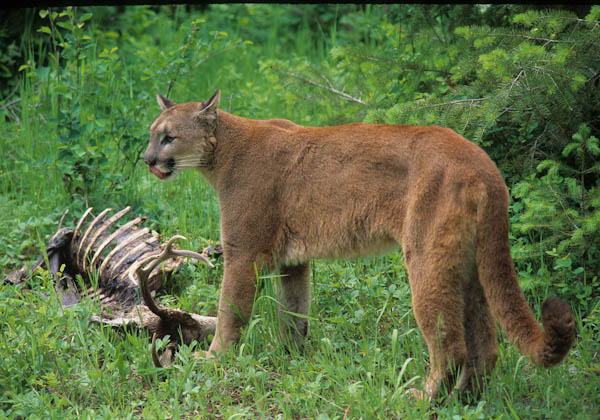
Photo by George Wuerthner
Fact
Research in Washington, Arizona, Colorado, California and other states shows that sport hunting does not reduce the risk of cougar attack or conflicts. In fact, it may increase the slight risk of attack by selectively removing large trophy cats, usually dominant males, leaving unnatural numbers of juveniles, the age class associated with conflicts and attacks. Additionally, hunting takes place in remote wilderness areas, not in populated areas, so the cats that hunters kill are not the cats that might cause conflicts. Read what WSU experts have found about the effects of over-hunting.
***************
Myth
Cougars are decimating deer and elk populations and must be managed to protect prey species.
Fact
Deer and elk populations are thriving throughout most of Oregon and other western states. Deer, elk and cougars have evolved together for millennia and depend on each other for healthy populations and habitat. Learn about the importance of predators.
Researchers at Oregon State University (OSU) have galvanized the scientific community with their work demonstrating how critical predators and cougars are to the web of life.
- As Predators Disappear, Ecosystems Suffer - OSU video
- Impact of a Cougar Decline on Zion Canyon, Zion National Park - PARKscience article
***************
Myth
Hound hunting is necessary to keep cougar numbers down and protect livestock
Fact
Hound hunting for sport was banned in Oregon in 1995. Since then the number of cougars killed in the state has more than doubled (see cougar mortality statistics). Hound hunting is allowed for public safety and to remove damage-causing cougars, it is only prohibited for use by trophy hunters.
***************
Myth
The livestock industry is suffering huge losses because of cougar killing sheep and cattle in Oregon.
Fact
The Oregon Department of Agriculture survey on wildlife damage showed that out of the $1.5 million dollars in livestock losses due to wildlife predation in Oregon, only .2 percent could be attributed to cougars. Statewide, losses to wildlife total over $158 million dollars, mostly due to elk and deer damage. That damage could be minimized by encouraging cougar and other predator population growth.
***************
What to Do If Confronted by a Cougar
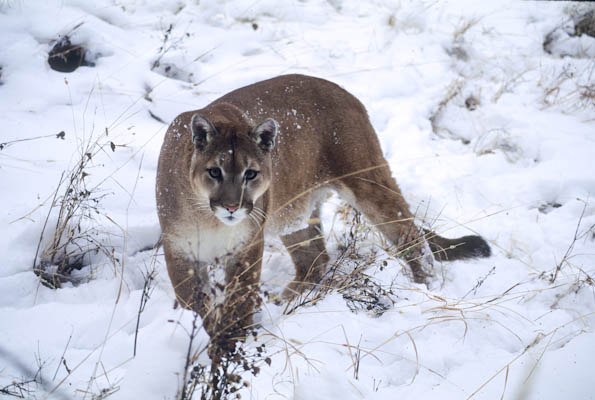
Photo by George Wuerthner
While cougars do not see humans as a menu item, they are cats! They will chase a moving target and may mistake small children and pets for prey.
If confronted by a cougar, never run. Instead make yourself look big and hold small children close to your body. Give the cougar room to escape, back up slowly and stay facing the animal.
Never corner a cougar, always give it an easy exit.
Oregon Cougars: An Overview
Oregon Cougar Management: A History of Persecution Driven by the Special Interests of Livestock Producers and the Trophy-Hunting Lobby
Up until 1960, there was a bounty on cougars in Oregon and no restrictions on hunting them. By the mid-1960's Oregon's cougar population was in serious decline and the big cats were practically eliminated from the state. In 1967 cougars were declared game animals, and restrictions on hunting were established which allowed the population to rebound.
In 1994 Oregon voters banned the unethical practice of sport hunting cougars and bears with packs of dogs. Sport hunting used dogs to chase the big cats to exhaustion, making them easy targets for trophy hunters to shoot off tree limbs for sport. While this was forbidden, using hounds to remove cougars that caused damage to property or threatened public safety was never prohibited or restricted.
The political backlash to the voters' decision to ban sport hunting was fast and furious. It continues to govern how cougars are "managed" by Oregon's decision-makers. In response to the unscientific notion that the cougar population would explode without hound hunting, the Fish and Wildlife Commission immediately directed the Oregon Department of Fish and Wildlife (ODFW) to take measures to keep the cougar population from expanding beyond their questionable estimated size in 1994 (3,000 cougars). Cougar hunting regulations were rapidly liberalized:
- the hunting season increased from two to four months to year-round
- the bag limit was increased from one to two cougars
- tag fees were reduced dramatically, from $50 to $10
- a cougar tag is now included in the Sport Pac license package
As a result of these changes, tag sales increased from 500 tags to a whopping 50,000 plus tags sold in 2011. These changes in regulation—made legislatively, by Oregon lawmakers, and by the Fish and Wildlife Commission—more than doubled the state's cougar mortality rate in 17 years. In 1994 Oregon lost 204 cougars; in 2011 Oregon lost 502 cougars.
The regulatory changes were accompanied by a well-planned and financed media campaign designed to convince the public that they were in danger from marauding cougars threatening their children and livestock. Every legislative session since 1994 bills continue to be introduced to gut or overturn the ban on trophy hunting cougars with dogs. And, remarkably, each session just before a scheduled bill hearing there is a cougar scare, usually in the form of a reported attack on a child. These alleged incidents make front page and prime time television when reported, but days later when proven to be a hoax (or a bobcat or house cat instead of a cougar), the facts are not reported. It is also important to note that the public is asked and directed to report all sightings of cougars to ODFW—and that all cougar complaints called in are recorded to justify the need to kill more cougars.
For insight on cougar sightings, read the opinion of Dr. Paul Beier, Ph.D., Northern Arizona University School of Forestry, who says reports of cougar sightings are worthless (or worse).
2006 - A Year of Shame: Management Plan Becomes Government Kill Plan
By 2005 the hunting regulation changes and associated media scare tactics made to counteract the presumed cougar population explosion had already succeeded in increasing mortality levels to over 400 dead cats. That was still not enough to keep up with the inflated population estimates based on ODFW's flawed computer model, which by 2005 had cranked the population up to more than 5,000 cats.
2005 marked the time for the required five-year review of Oregon's Cougar Plan, and an opportunity for ODFW to address their inability to keep mortality rates up with the sky rocketing population estimates. Thus the infamous 2006 Cougar Management Plan was born.
The pretext for the 2006 Plan was to increase public safety, although there has never been a documented cougar attack on a person in the state's history. But the single focus of the Plan was to kill more cougars. It contained no educational component and made no attempt to promote coexistence, to provide tools to improve livestock husbandry, or to better respond to legitimate damage or safety issues. Instead, the Plan set up "target areas" within which government agents can indiscriminately kill every cougar they can locate, using traps, snares, and packs of hounds. While the Plan involved a detailed description of the project, using scientific buzz words such as "adaptive management strategies," it is based on nothing more than solicited public complaint reports to determine where the killing areas are to be located, along with maximum kill levels extrapolated from a small study in Utah (made under very different conditions than are found in Oregon).
The Plan was sent out for peer review to a very limited group of scientists. Predator Defense increased that field by sending it out to more scientists. The response to the peer review was spectacular. The best minds in cougar research condemned the methodology, from the population modeling to the use of unreliable complaint data as criteria for killing cougars. In short, the majority of reviewers agreed with our conclusion that the document defies and/or twists the findings of cougar research in order to justify killing more cougars and to keep Oregon's cougar population static (at an arbitrary level of 3,000 cats determined by a politically appointed body in 1994).
A Cloak of Darkness Falls over the Killing Fields
The state's reaction to the peer review response was predictable, if unconscionable: it was ignored and no changes were made. Then in 2011 the Commission agreed to the ODFW's request to abolish the rule to review all management plans every five years. This leaves management plans for wildlife without oversight, regular review, or any need to keep up with and incorporate current research findings into the state's management strategies.
Fortunately, one of the top cougar experts in the country, Dr. Robert Wielgus, had his say before the decision to ban reviews came to pass. Read "Top Cougar Biologist Weighs In."
We wonder if the Plan will ever again be exposed to the light of scrutiny by the public or science, and if Oregon's cougars are destined to be continued to be slaughtered in the dark.
2012 Forward - Oregon Cougar Plan: Where the Killing Is | Safety Takes a Back Seat to Hunting
Without required regular review, the 2006 Cougar Managment Plan remains in place into perpetuity. Predator Defense will continue to object, to seek out and obtain kill numbers for the record, and to make them and any other information we find available to the public.
Proposals made for 2013 Big Game Regulations (see cougars on page 22) give no further pretense to the objective of the 2006 Plan by clearly stating the following: "Currently four target areas have been implemented to address declining ungulate populations." In other words, the government is killing natural predators so hunters will have a better chance to kill their prey, deer and elk, for sport. This exclusive focus on improving sport hunting conflicts with the stated purpose of the Plan, which is public safety.
Since the beginning of the 2006 Plan, approximately 260 cougars have been indiscriminately killed in target zones by agents. The vast majority of these kills (more than 80%) have been in prime sport hunting areas in northeast Oregon. Of the 502 cougars killed by all sources in 2011, approximately 71 were hounded and shot or trapped in snares by government agents in target areas located in prime cougar and ungulate habitat. See cougar mortality stats
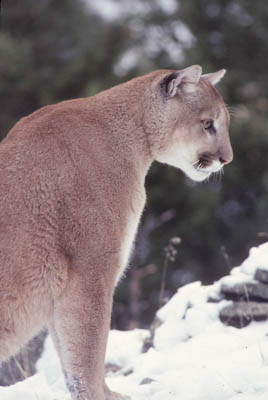
Photo by George Wuerthner
Although kittens and sub-adults were killed, the majority of cougars were adults. Indiscriminate killing like this removes dominant animals from their territory, opening the area up to juveniles—the age class responsible for the majority of conflicts with people and livestock. Rather than improving the very slight risk of danger from cougars, the plan is actually increasing risk to the public and livestock. See Top Cougar Biologist Weighs in on Oregon’s Cougar Management Plan and Cougars in Chaos
Top Biologist Weighs in on Oregon’s Cougar Management Plan
In his report on the Oregon Cougar Management Plan, Dr. Robert Wielgus, former director of the Large Carnivore Conservation Lab at Washington State University, asserted that the plan, adopted by the Oregon Fish and Wildlife Commission in April 2006, lacks any scientific credibility.
Dr. Wielgus contends that the authors must go back to the drawing board and begin again. “The authors should consult with reputable wildlife scientists and statisticians to obtain a reliable experimental design, analysis and report. We recommend they consult with Scientists at Oregon State University, University of Oregon, or another research university to design a scientifically credible study.”
He further contends that no valid scientific conclusions supporting the beneficial effects of administrative removal of cougars can be drawn from this study. No scientific evidence was presented showing that administrative removals achieved any of the stated goals (reduced complaints, livestock depredations, and increased number of elk calves).
Cougars in the News
- P-22, L.A. celebrity mountain lion, euthanized due to severe injuries - Los Angeles Times, Dec. 17, 2022
- Evidence does not support hunting as a way to control cougars: Study - OPB.org, Feb. 24, 2020
- Cougar management: Science, not supposition - Op-ed by predator prey ecologist John Laundre, Ph.D, in Mail Tribune, Feb. 3, 2019
- Oregon May Be Over-Hunting Cougars — Which Could Cause More Conflicts - Oregon Public Broadcasting, Nov. 7, 2018
- Predator advocate responds to recent hiker death: Brooks Fahy criticizes the effort to find and kill the cougar - Eugene Weekly, Sept. 13, 2018
- Too many deer on the road? Let cougars return, study says - New York Times, July 18, 2016
- Cougars in the crosshairs - Editorial in The Register-Guard, Nov. 16, 2015
- Famous cougar holed up under house returns to wild - Adventure Sports Network, Apr. 14, 2015
- Critics say cougar in Bend shouldn't have been killed - Bend Bulletin, Feb. 8, 2015
- Wildlife agency promotes slaughter of cougars - Op-ed by Brooks Fahy, executive director of Predator Defense, in The Register-Guard, Mar. 25, 2014
- Cougars in Chaos: How a state hunting policy pushed Washington's big cats to the brink - by Liza Gross, High Country News, Apr. 14, 2008
- Cougar attack in Oregon a hoax - Oregonlive.com Statewide Bulletins, April 11, 2005
The Science on Cougars
- The ecology of human-caused mortality for a protected large carnivore -
John F. Benson, Kyle D. Dougherty, Paul Beier and Justin A. Dellinger. Proceedings of the National Academy of Sciences (PNAS), Mar. 20, 2023 - The elephant in the room: What can we learn from California regarding the use of sport hunting of pumas (Puma concolor) as a management tool? -
John W. Laundré, Christopher Papouchis. PLOS ONE, Feb. 13, 2020 - Hunting as a management tool? Cougar-human conflict is positively related to trophy hunting - Teichman, Kristine J; Cristescu, Bogdan; Darimont, Chris T. University of British Columbia, Oct. 11, 2016
- Effects of Remedial Sport Hunting on Cougar Complaints and Livestock Depredations - Kaylie A. Peebles, Robert B. Wielgus, Benjamin T. Maletzke, Mark E. Swanson. PLOS ONE, Nov. 19, 2013
- The Effects of Over-Hunting - Washington State University, Department of Natural Resource Sciences, 2012
- Update: Critique of Oregon Cougar Management Plan - Rick A. Hopkins, Ph.D., Sept. 11, 2008
- Debunking the Urban Cougar Myth - Rick A. Hopkins, Ph.D., Jan. 23, 2007
- Cougar predation key to ecosystem health - David Stauth & William Ripple, funded by National Park Service, Oct. 24, 2006
- Ecologists Rick Hopkins & Barry Noon respond to Draft Oregon Cougar Management Plan - October 2005
- Human-Cougar interactions in Oregon - Rick A. Hopkins, Ph.D, May 6, 2003
Historical Data on Oregon Cougar Deaths
- Trends in Cougar Deaths in Oregon, 1992-2018
- Oregon Department of Fish and Wildlife

Spotlight on Cougars
- Overview: "He's One Cool Cat"
- Cougar myths debunked
- Cougars in the news
- The science on cougars
- What to do if confronted by a cougar
- Data on Oregon cougar deaths
- Media press kit
Other Animals at Risk
How You Can Help
With your help we can expand our efforts to save native predators and stop illegal hunting, trapping, and extensive predator-killing programs.
Make a difference. DONATE TODAY!
"For the animal shall not be measured by man.
In a world older and more complete than ours,
they move finished and complete, gifted with
extensions and the senses we have lost or
never attainted, living by voices we shall
never hear. They are not brethren, they are
not underlings, they are other nations."
- Henry Beston